
Plants to Go ->
Raw: Water values
Water values:
Water values, something that is easily overlooked, but is certainly of great importance.
In this blog we discuss water values; what they stand for, what the correct values are and what to do if the values become unbalanced.
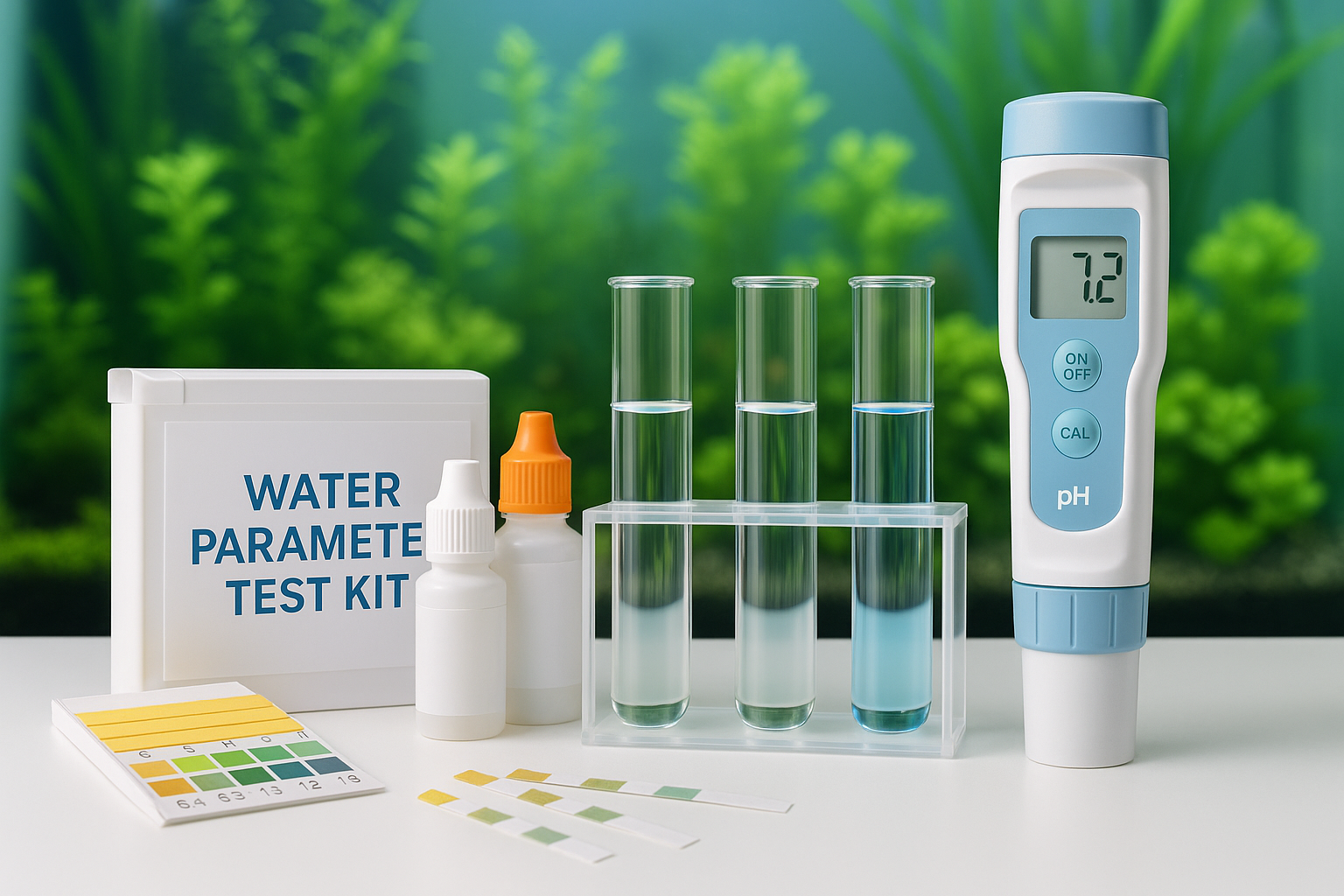
For a global overview you can use the 6 in 1 test strips.
If you notice that certain values are too high or low, always use the specifically targeted tests.
At the bottom of this page you will find links to useful tools and products that can help you further.
Let's first look at the different water values and what they stand for:
-
PH value (Acidity of your water)
-
GH value (Hardness of your water)
-
KH value (Carbonate hardness of your water)
-
O2 (Oxygen content of the water)
-
CO2 value (CO2 value of your water)
-
NO2 value (Nitrite value of your water)
-
NO3 value (Nitrate value of your water)
-
Fe value (Iron value of your water)
-
PO4 value (Phosphate value of your water)
-
NH3 value (Ammonia value of your water)
-
NH4 value (Ammonium value of your water)
-
Cl value (Chlorine value of your water)
-
Cu value (Copper value of your water)
-
SiO2 value (Silicate value of your water)
We will go into more detail about the values; which values are good, which values are bad and how you can get them back into balance.
Also what to do in extreme cases of excessively high values.
PH value
The pH value stands for acidity and we want to keep it as neutral as possible.
The optimal value is between 7 and 8 PH.
The value will fluctuate during the day, so make sure you take measurements often at the same time during the day.
This is due to the light and the plants in the water as they do their work.
As the water heats up due to the lamp, the pH will drop.
If the pH is too high, you should actually change 50% of your water.
If the pH is too low, it can sometimes help to add some CO2 to the water.
This can be done with a carbo extract, such as the Hs Aqua Flora Carbo, a CO2 system or CO2 tablets.
If your pH value is still not in order after these actions, you can use the PHplus or Phminus.
GH value
The GH value represents your water hardness.
This often has to do with the lime level in your water.
For people with a water softener, these values will be almost 0 and the water will not be suitable for starting an aquarium.
The optimal GH value is between 8 and 12; this is medium hard water.
If the GH value is too low, you will see that the growth of your plants will be inhibited and in some plants it can even lead to the leaves becoming snotty.
In short, GH is partly the food for your plant and therefore try to handle it carefully.
Too high a GH also brings its own problems, although this is a less common phenomenon.
Too high a GH can cause salts to form that will draw moisture from the leaves and these salts will also affect your other water values.
The best thing to do in case of a level that is too high or too low is to change the water.
Start with 25% and check the level again after 2 days and repeat the step if necessary.
If the GH level remains too low, you can use liquid fertilizer to provide the plants with sufficient nutrition.
If this still does not produce any results, there is also GHplus from Hs Aqua.
KH value :
The KH value represents the carbon hardness in your water.
This value is more of a connection between other values in your water and therefore this value is often neglected. This is because this value often rises or falls with the GH value.
The compound that KH makes is potassium, magnesium and carbon dioxide.
The optimal value is between 5 and 10, although for cichlid fish it is better to have a slightly higher value between 7 and 10.
Increasing and decreasing this value often goes hand in hand with the GH value. It is best to change the water for about 25-50% and see what this does to the values.
If the value is still too high, you can add peat to your filter material, which will lower the KH value level.
There are also HS resources that can increase or decrease your KH.
O2 values :
The O2 values represent the CO2 content in your water.
This value is very important for many plants and you will encounter it a lot.
It is the basic food for many plants and is a must have if you want to keep plants without chlorophyll in your tank.
CO2 can be added to your water in many ways.
You can keep this value at a good level by using a CO2 system, some liquid fertilizer or CO2 tablets.
The value of CO2 level in your water you should calculate yourself. This can be done by the number of bubbles per minute (this can be done with a bubble counter) and try to keep it between 5 and 10.
The calculation goes as follows:
The number of bubbles per minute is the number of liters of water times the carbonate hardness divided by 50.
Or: Number of bubbles = (Liters of water x Carbon hardness) / 50
There are easy systems that can take over a lot of the work, although they are often expensive.
NO2 values :
The NO2 values represent the nitrite content in your water.
This is a substance that is usually converted by the bacteria in your water into nitrate and then absorbed by your plants.
The substance comes from faeces or dead fish and therefore the value should be monitored more closely in tanks with predatory fish or tanks where live/frozen food is used.
Too high a level in your water can cause major problems in your tank and ultimately lead to the death of your inhabitants.
Therefore, the advice is that if you find this value higher than 0.5 mg in your tank, it is best to change 50% of the water and check the values again the next day and repeat the step if the values are still too high.
If these steps do not help, seek help from a fish specialist/aquarium specialist. These people can help you further with a long-term solution.
You will see that when NO2 and NO3 values are increased, fish will rise to the surface of the water to take in oxygen.
So keep a close eye on this value!
NO3 values :
The NO3 values represent your nitrate content in the water.
The substance, like NO2, comes from an accumulation of dead matter in your aquarium.
At this stage the bacteria have already broken down the nitrite, but there is more present in the aquarium than the plants can absorb.
If the NO3 level is too low, your plants will be dependent on other nutrients or fertilization.
Too high a NO3 level will create a toxic environment for your fish.
Fortunately, the chance that it reaches these toxic values does not occur often.
If the NO3 level is too high, it is best to change 50% of your water and check the values the next day and repeat the step if necessary.
In the longer term, there are options to feed your fish a little less or add more plants (if possible).
A healthy amount in water will be below 20mg/litre; anything higher can be considered dangerous.
The values can also be adjusted with HS aqua products.
Fe values :
The Fe values represent the amount of iron in your water.
In addition to GH and KH, iron is also an important substance for your plants.
A deficiency in these values will result in plants that do not thrive or die and can often be recognized by their yellow color.
An excess of iron will be toxic to your aquarium fish.
This is evident because the fins of the fish are affected.
To prevent this, you can change the water more frequently.
If the level is too low, you can fertilize with iron-rich fertilizers.
Optimal value is between 0 and 0.5 mg/l.
PO4 values :
The PO4 values represent the phosphate content in your water.
This is an important substance that helps your plants convert CO2 into sugars.
Besides this property, it will also enhance the color of your leaves.
An ideal value for PO4 is 0.5 mg/l.
Too high a PO4 value in combination with too high an ammonium content can become a breeding ground for various types of algae.
If the PO4 value is slightly on the high side, this is not yet a serious problem.
Just like with the NO3 values. In the long term it can sometimes help to feed your fish a little less.
Other solutions to balance the PO4 level are to change the water or use HS Aqua balance PO4 plus or PO4 minus.
You can also use Sera Phosvec with your filter material to reduce the PO4 value.
NH3 values :
The NH3 values represent the ammonia content in your water.
NH3 is a very harmful substance and we do not like to see it in the water.
Too high a value can lead to ammonia poisoning.
This starts by damaging the gills and over time will cause your inhabitants to suffocate and die.
Although you will be able to see from the PH and NO2 values that your ammonia may be high with a multi-test strip, it will not be immediately clear.
It is best to check these values with specific tests.
The best way to lower the values is to change your water and, if possible, change it again after a week.
Unfortunately, there are no resources that can influence the water values of NH3.
If you experience long-term problems with the NH3 or NH4 values, please contact a fish/aquarium specialist.
NH4 values :
The NH4 values represent the ammonium content in your water.
This value is closely related to the NH3 value of your water.
A too high NH4 level may not be immediately harmful, but it does indicate a dirty aquarium.
This can become a breeding ground for the wrong bacteria and can promote your NH3 value.
Too high a NH4 and PH value will cause the formation of NH3 and as you may have read, this can cause a lot of damage to your aquarium inhabitants.
As with the NH3 values, the best way is to change some of your water and repeat this after a week, if the values are still too high.
Unfortunately, just like with NH3, there is no miracle cure or way to treat NH4.
If you have long-term problems with NH4 or NH3, contact a fish/aquarium specialist.
Cl values :
The Cl values represent the amount of chlorine present in your water.
Chlorine is often found in newly set up aquariums and aquariums that are frequently changed.
Unfortunately, chlorine is present in many places in tap water and is therefore unavoidable.
Although a little chlorine is not a big deal, it can become a problem if there is more than 0.02mg/l in the water.
For the aquarium inhabitants it then becomes a corrosive substance and will affect the skin and eyes.
To keep these values low, it is recommended to use a water conditioner when changing and filling the tank.
Cu values :
The Cu values represent the amount of copper in the water.
Just like chlorine, we find traces of copper in our tap water.
However, these are not substances that we want to encounter in the water.
At values above 1.0 mg/l it is fatal for all aquarium inhabitants and at 0.3 mg/l for snails and molluscs.
To reduce these values, it is best to change the water.
Water without copper values in it or treat the water with a water conditioner.
In case of long-term problems with a Cu content that is too high, please contact a fish or aquarium specialist.
SiO2 values:
The SiO2 values represent the amount of silicate in your water.
Silicate has a major influence on algae growth in your aquarium.
When the water has more than 0.4 mg/l SiO2, you will see algae growth slowly starting to occur.
SiO2 is also a nutrient for your plants and is not harmful to your aquarium.
To prevent algae growth, you can expand the filter with a UV filter or lamp and keep your filter clean.
In addition, you can use Hs Aqua Flora Carbo power to boost your plants and suppress algae.
For long-term problems with algae, contact a fish or aquarium specialist.
Leave a comment